10 Questions with Brandon Hanson
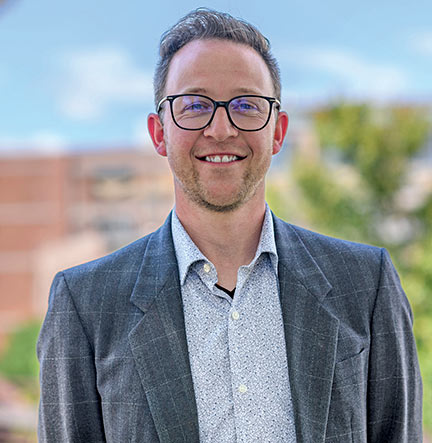
Brandon Hanson is the CEO of Downtown Sioux Falls, Inc., where he leads efforts to support a vibrant, thriving downtown. Previously, he led EmBe’s childcare and school-age programs and advanced from Exhibitions Assistant to Director of Museums at the Washington Pavilion, where he managed major projects and launched the Pavilion’s Sculpture Walk partnership. Known for his collaborative leadership style, Hanson focuses on building strong relationships and creating meaningful community impact. He lives in Sioux Falls with his wife, Brittany, and their daughters, Scarlet and Juliet.
What surprised you most about stepping into the leadership role at Downtown Sioux Falls?
How much more impact we can have. DTSF is nearly 40 years old, but we’re at a moment where we can build on an incredibly strong foundation and step into work that wasn’t even imaginable decades ago. I was surprised by how respected this organization is and how critical it is to the broader community, not just to people who attend events. Much of our work shapes what downtown will look like for future generations. It’s often invisible and hard to quantify, but it carries deep purpose. We’re caretakers of something bigger than ourselves, carrying the torch forward to ensure downtown outlives us.
What skill has become more important to your job over time?
Relationships. Full stop. Every membership, sponsorship, partnership, hire, or job application ultimately comes down to one thing: people deciding whether they want to invest their time and energy with you. Money is secondary. Time is the most valuable resource we have, because it’s the only one we can’t get back. That reality has made authenticity, genuine curiosity, and a willingness to go first incredibly important to me. Strong relationships aren’t transactional. They’re built through trust, consistency, and showing up before you’re asked.
What makes downtown Sioux Falls different from downtowns in other Midwest cities?
Collaboration is a major differentiator. The level of public-private partnership we have is rare, especially in a market our size. You see it in projects like Jacobson Plaza, the Steel District, and the Cherapa Complex. We are one of the most ammenitized Downtowns in the country. The Downtown Ambassador Program is another standout. Property owners voluntarily chose to self-tax to invest in shared services for the district, which is almost unheard of in South Dakota. That investment has resulted in a program that handles hospitality, cleanliness, maintenance, and direct engagement with those experiencing homelessness.
What does responsible leadership look like in a community-facing role?
For me, leadership and service are inseparable. Responsible leadership starts with managing myself, which is often the hardest part and the only thing I can truly control. If we want accountability, we have to be willing to follow up. If we want trust, we have to be consistent. Community-facing leadership means showing up with humility, clarity, and a willingness to do the work even when it’s unseen or uncomfortable.
What is something you are especially optimistic about for downtown Sioux Falls right now?
More than anything, it’s the people. Downtown is filled with business owners, residents, and employees who believe in quality over quantity, and that mindset shows up everywhere. In how businesses operate, in how partnerships form, and in how people treat one another.
I’ve only been with Downtown Sioux Falls Inc. for about a year and a half, but I can’t walk anywhere downtown without someone honking or waving hello. The relationships are authentic. People genuinely care about each other and about producing work that benefits the entire community.
How do you see the Chamber and Downtown Sioux Falls Inc. working together to support local businesses?
I view the Chamber and DTSF as deeply symbiotic organizations. Downtown is often described as the heart of Sioux Falls, and our work at DTSF is focused on caring for that heart: the built environment, economic development, placemaking, activation, and driving foot traffic. The Chamber operates with a broader lens and provides layers of support that are critical at a citywide and statewide level, particularly around advocacy and policy. If downtown is the heart, the Chamber helps care for the nervous system.
We’re proud members of the Chamber, and when people ask me which organization they should belong to, my answer is always both. Downtown environments are complex, and it takes multiple organizations working together to keep the engine running smoothly.
What’s a moment in your career that shaped the way you lead today?
My time at the Washington Pavilion was completely formative. I was given trust and opportunity over and over again. I was allowed to try things that didn’t have a clear rulebook, to experiment, to fail forward, and to stretch far beyond what I thought I was capable of.
At the same time, I was being pushed constantly by a leader who expected more, while I was also going through an accelerated MBA program and leading people for the first time. It was my first real exposure to the weight of leadership. The responsibility. The accountability. And honestly, the loneliness that can come with a title.
What is a piece of advice you’ve received that has served you well?
Focus on incentive instead of restriction. Pull, don’t push.
It’s easy to get impatient and want to force progress, but incentivizing the behaviors and outcomes we want to see is far more effective. Building unity and shared momentum takes time, but it produces lasting results.
Do you have any daily habits or routines that keep you grounded?
I usually wake up around 5 a.m. and spend a couple of hours thinking, listening to podcasts, and planning the day ahead. It’s quiet, intentional time that helps me lead with clarity instead of reaction. When I’m home in the evenings or on weekends, I work very hard to shut things off. That time is sacred. I’m also becoming more aware of how important exercise, quiet space, and clear boundaries are, not just for my own health, but for being a better leader and parent.
When you’re not working, where can we usually find you?
Mostly at home. My three girls and our golden doodle are everything to me. They are the real “why” behind the long hours and strong work ethic.
I want them to grow up in a community that is cared for, where neighbors know each other, and where people are invested in the place they live. My wife and I also love the arts and attend as many shows as we possibly can. That creative energy fuels both our family life and my work.