
Flying in the Face of Fear: Kim Campbell’s Lessons in Courage and Leadership
Kim Campbell brings lessons in courage, leadership and resilience to Sioux Falls
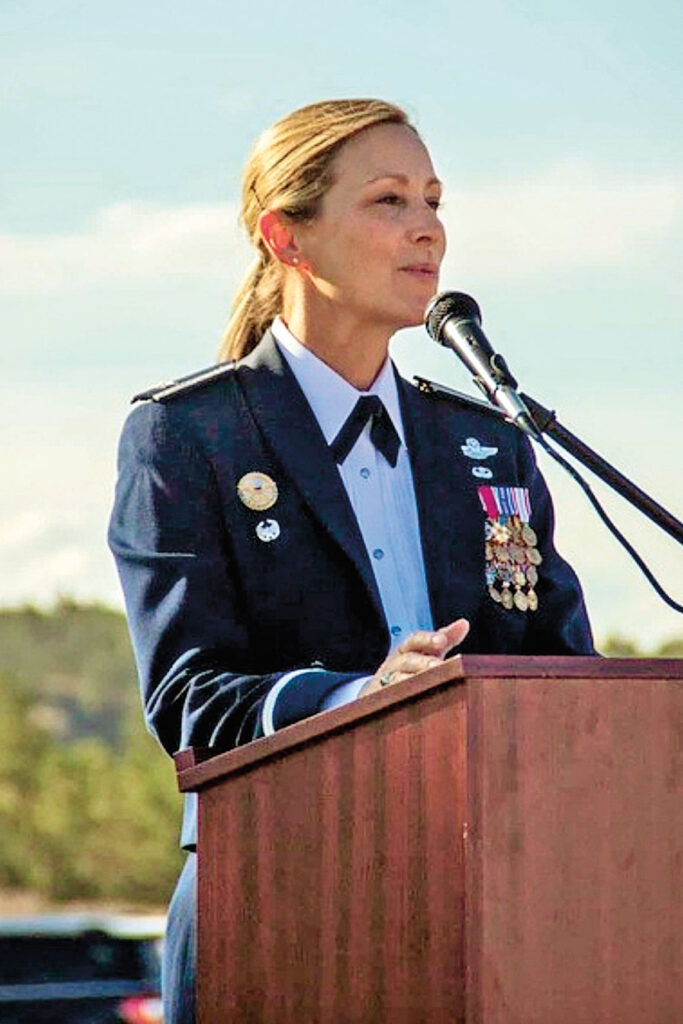
On April 7, 2003, Capt. Kim Campbell had to make a decision that would significantly impact the rest of her life — and she had only seconds to make it.
Campbell was flying an A-10 Warthog over Baghdad, three weeks into the armed conflict with Iraq. She and her flight lead had been sent after an Iraqi command post when a call came in from a forward air controller on the ground: soldiers from the Army’s 3rd Infantry Division were pinned at a bridge over the Tigris River and taking rocket-propelled grenade fire. Campbell dropped below the weather, identified the friendly and enemy positions and made several passes with the aircraft’s 30 mm gun and high-explosive rockets.
Coming off the last pass, she heard what she has described as the loudest explosion of her life. A missile had struck the tail of her airplane. Both hydraulic systems failed instantly. The jet rolled left, pointed toward the ground over Baghdad and stopped responding to anything she did with the controls.
Ejecting over the city was not a choice she wanted to make. Instead, she switched the airplane to manual reversion, an emergency backup system that uses pulleys instead of hydraulic assist. The Warthog began to climb, and she flew it more than 100 miles back to her base in Kuwait and landed it on a runway lined with crash crews and rescue helicopters. She landed using an approach she had never been permitted to practice because it was considered too dangerous.
She was back in the air the next day. She was later awarded the Distinguished Flying Cross for heroism.
On Thursday, Nov. 12, retired Col. Kim “KC” Campbell will share her story in person at the South Dakota Military Heritage Alliance during A Night with Heroes.
Kim Campbell at a glance
Campbell’s story does not end at the runway in Kuwait, and that is precisely why the business community should pay attention.
Over a 24-year Air Force career, she flew more than 1,800 hours in the A-10 and more than 100 combat missions in Iraq and Afghanistan. She went on to command a group of more than 1,000 people spread across South America, Central America and the Caribbean. She served as military assistant to the Under Secretary of Defense for Policy, was an Air Force senior fellow at the Atlantic Council and finished her career as director of the Center for Character and Leadership Development at the U.S. Air Force Academy. She is a Marshall Scholar with an MBA from the University of London.
She is also the author of the bestselling Flying in the Face of Fear: A Fighter Pilot’s Lessons on Leading with Courage and now speaks to corporate audiences worldwide on decision-making under pressure. Anyone who has run a company through a supply-chain shock, a key-employee resignation or a bad quarter will recognize the terrain.
Four ideas you can put to work on Monday
Aviate, navigate, communicate. It is the pilot’s order of operations, and it is a triage rule for any leader whose day has gone sideways. Fly the airplane first. Then figure out where you are. Then ask for help.
Chair flying. Long before she needed manual reversion, Campbell had rehearsed it sitting in a chair with a paper cockpit taped to the wall, walking through emergencies she hoped never to see. Preparation is not just for when things go right; it is for the contingency you have not budgeted for.
The debrief. Fighter pilots debrief every flight with rank set aside and ego turned off. Campbell argues that most organizations never improve because they never do this honestly. It is a process improvement tool that costs nothing but discomfort.
Wingman culture. Her central leadership idea is that nobody should be flying alone. Onboarding, mentorship and retention are critical to success, especially in tight labor markets.
A workforce story, too
A Night with Heroes is not only a keynote. The evening includes a welcome home to recognize South Dakotans who are retiring from or honorably completing active-duty service, along with a swearing-in ceremony for those about to enter it.
Every service member who chooses to come home to South Dakota is an experienced, mission-tested addition to the local workforce, and their integration into the community shapes whether they stay. For Chamber members who hire, sponsor or mentor, this is an opportunity to be visibly part of that transition rather than a casual observer to it.
There is a fitting symmetry here. Asked what the best part of that April day in 2003 was, Campbell said it was hearing the voices on the radio as she came home. Just “welcome home,” and knowing she had made it.
On Nov. 12, Sioux Falls will have a chance to say “thank you” to veterans who recently chose to call greater Sioux Falls home and those who are already deeply rooted in our community.