
Made in Sioux Falls: The Products and People Behind Local Manufacturing
From breakfast foods to water towers, local manufacturers make more than you might realize — and their impact reaches far beyond Sioux Falls.
The average Sioux Falls resident probably doesn’t spend a lot of time thinking about how the carbonation got into their soda, where the eggs in their breakfast sandwich were cooked or where their neighborhood water tower was constructed.
So it might come as a surprise to learn that all of those things and more are manufactured right here in Sioux Falls.
Within the metro area, businesses are making everything from commercial-grade donut glazers to dog kennels to the video boards at local college football games.
Manufacturing is in the top 10 fastest growing industries in South Dakota, accounting for $7.5 billion of the state’s gross regional product, according to data from South Dakota Trade. Of that number, $1.9 billion comes from the manufacturing sector in Minnehaha and Lincoln Counties.
That includes a wide range of businesses and products, and beyond the products themselves, Sioux Falls’ manufacturing industry also has a significant impact on the local job market. Statewide, data from Wiser Trade shows that there are 32,437 jobs supported by export, and an estimated more than 13,000 of those jobs are in the Sioux Falls metro.
Many of those jobs go largely unseen — tucked away in industrial parks and warehouses, but the impact of that work is critical not only for the local economy, but also for the national and global sector. Local manufacturers are sending products from Sioux Falls to all 50 states and across the globe.
“A lot of the manufacturers that do business in South Dakota are from, maybe, researchers out of some of the higher education institutions or business men and women who left and came back — established their business in-state and have grown that from there,” said Kallie Ruland, trade specialist with South Dakota Trade, a nonprofit that promotes partnerships between foreign buyers or investors and South Dakota companies. “I think we have seen a lot of success stories of the spirit of entrepreneurship across the State of South Dakota.”
Why manufacturing businesses choose Sioux Falls
One example of that spirit of entrepreneurism is Grand Prairie Foods, founded by Kurt and Valerie Laudenback in 2003. The couple purchased a small meat company called Dakota Foods, rebranded and began as a business selling portion-controlled meat products in the food service industry.
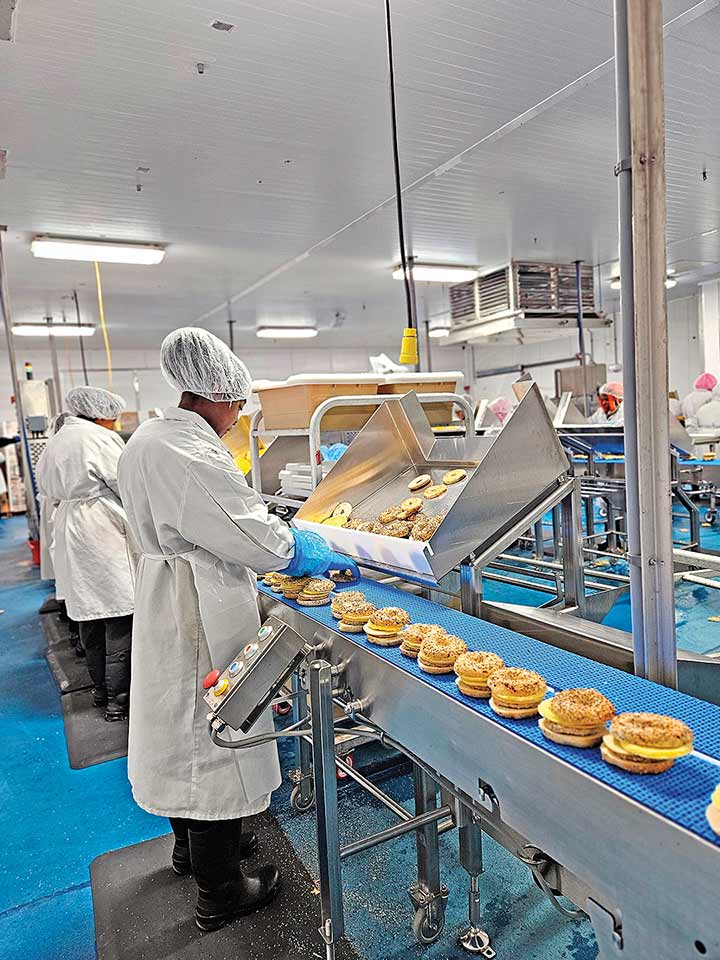
From there, Grand Prairie Foods expanded to supplying scrambled eggs to hundreds of hotels, starting with the Hampton Inns in North Carolina, as well as breakfast burritos and sandwiches. Today, Kurt Laudenback estimates the company has as much as 50% of the market share of egg-based burritos in retail.
In Sioux Falls, Grand Prairie Foods has three facilities — an egg processing facility, a facility that almost exclusively produces sandwiches, and a storage and distribution facility. The company employs roughly 300 people and ships products to all 50 states. If you’ve ever had scrambled eggs at a Hampton Inn, a breakfast burrito at a Circle K gas station or a sandwich from Scooters Coffee, you’ve had Grand Prairie Foods products.
Part of what makes this area attractive to manufacturers like Grand Prairie Foods is South Dakota’s business-friendly climate.
“We’re pretty fortunate that we live in a state where we’re free to do business as we please with little interference from the government,” Laudenback said.
Sioux Falls is also in a good spot geographically for shipping purposes, with easy access to both interstates and railroad.
One of the lesser-discussed “exports” across the state is South Dakota’s highly skilled labor force. Ruland said she’s seen the manufacturing sector attracted to the state because of the both hardworking and highly skilled labor force.
“We bring a lot of professional services and technical knowledge out of the State of South Dakota that goes and consults on a lot of projects internationally,” Ruland said, adding that firms with in-house engineers, designers, etc. are also often finding talent from South Dakota’s higher education system.
Managing workforce challenges
While the workforce is strong in the state, Sioux Falls’ low unemployment rate does create challenges for manufacturing companies — particularly when it comes to entry-level jobs. That means, finding creative ways to retain existing employees is the name of the game for a company like Maguire, one of the only businesses in the country that does both water tower construction and maintenance.
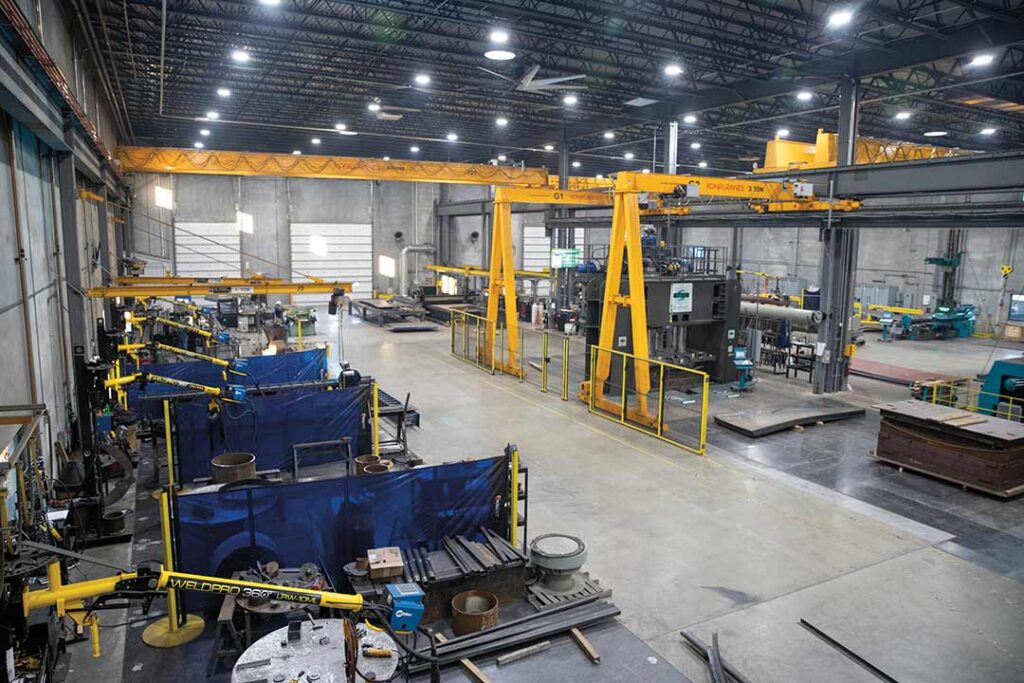
Maguire has 285 full-time employees, and about half of them work out of Sioux Falls, according to Brian Cooper, vice president of organizational performance.
Cooper said finding personnel can be a challenge, and Maguire has had to be intentional over the years about both attracting and retaining workers. That led to the creation of “Maguire University,” launched this year as a training program to get new workers up-to-speed on the water tower industry.
Additionally, Maguire built a new office and fabrication facility on Interstate 90 about two years ago as a means to increase capacity. That facility is the first in the state to have a Fitwel Certification, meaning the building is designed with health, happiness, resilience and quality of life in mind. That includes amenities for employees like walking paths, natural lighting in the fabrication center and an onsite fitness center. The facility also employs state-of-the-art technology with an emphasis on not only productivity, but also safety.
“One of our core values is commitment to safety,” Cooper said. “We need to make sure our team members are as safe as possible, and also how do we make them as comfortable as possible and give them a great place and great experience when they come to work.”
For Diamond Mowers, which produces commercial-grade land management equipment, largely for the agricultural sector, finding employees is made easier by being engaged in the community. The company is intentional about being visible in the community, said Cindy Newman, vice president of human resources.
That can look like participating in community boards. Newman, for example, is the board chair for Habitat for Humanity. It can also look like leveraging relationships through the Greater Sioux Falls Chamber of Commerce.
“The biggest thing is that we get our name out,” Newman said. “Being a part of the Chamber has helped us retain employees because the next generations want companies that give back, that are involved.”
Headwinds in the industry
While businesses are finding creative solutions to workforce challenges, there are some headwinds in the trade industry that don’t have a local solution. Tariffs decided at the federal level are adding significant cost increases to local manufacturers, and rising fuel prices due to conflicts in Iran are also piling on the costs when it comes to distribution.
“It’s tens of thousands, if not hundreds of thousands, of dollars,” Laudenback said.
Another challenge for manufacturers that rely on specialized equipment is finding people who can perform maintenance and repairs. Ruland shared the example of a business who had to pay more than six figures to fly in and do this type of work.
As with many businesses right now, manufacturers are working to find ways to pass those cost increases onto the customer, but that brings its own slate of challenges.
For Maguire, as well as companies like Diamond Mowers, there’s also the challenge of federal funding. Federal subsidies can dictate whether a farmer can afford to purchase a new brush cutter, for example, or whether a city can afford to rehabilitate an aging water tower. And interest rates can make a major difference.
“A brush cutter can cost $15,000 or $45,000,” Newman said.
For some manufacturers, workforce concerns extend beyond recruitment and retention. For Laudenback, it’s meant an extra sensitivity to the immigrants on his team. “That group of people is also under siege,” Laudenback said, noting that, though his workers have been largely unaffected so far, they are still afraid. “I’ve got people that are uneasy about how things stand even though they’re perfectly legal and have the right documents.”
Manufacturing in the future
Despite the challenges, manufacturing businesses in Sioux Falls have a lot to look forward to.
Diamond Mowers is one of many local examples of manufacturing businesses that are committed to new innovations and technology. The business — which has close to 200 employees in Sioux Falls — manufactures equipment for land management, from clearing brush to mulching entire trees.
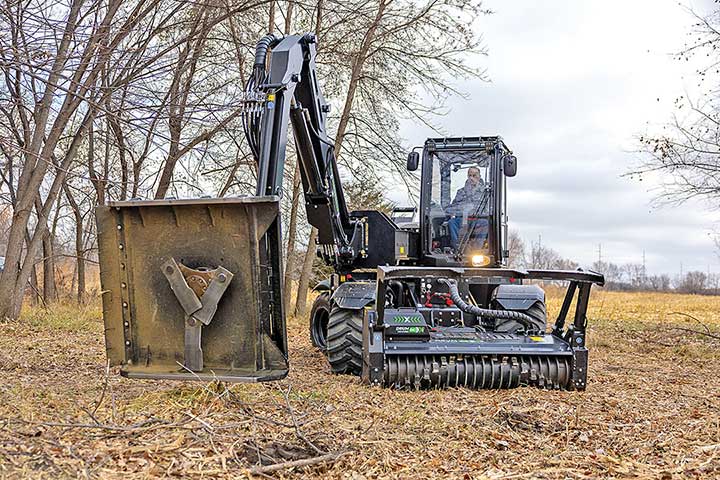
Diamond Mowers recently released a new DM360 product, which is an all-in-one vehicle to tackle everything from stump grinding to ditch clearing. Newman said the company is always looking to innovate, sharing examples of adding robotic welding, a new belt drive and automation technology in the warehouse.
“Automation continues to enhance the business,” Newman said. “It doesn’t replace our employees.”
That’s a trend Ruland sees continuing into the future, too — automation as a way to find efficiencies, but not necessarily to replace jobs.
“I don’t see automation necessarily replacing high-demand jobs, but rather helping manufacturers address positions that are repetitive, difficult to fill, or challenging to retain employees in,” Ruland said. “This could allow manufacturers to increase productivity while making better use of the workforce they already have.”
It’s hard to know what the manufacturing sector could look like in Sioux Falls 20 years from now with the rate of technological advancements, but in the near future, there’s continued momentum and growth on the horizon.
And, in some cases, manufacturing is just another way to put Sioux Falls on the map by attracting new people and new businesses to the state. Diamond Mowers, for example, invites dealers to come see its Sioux Falls manufacturing facility several times each year.
It’s also important to note that the manufacturers aren’t just making products to send out-of-state. They’re making products used by locals, too.
Diamond Mowers has sold commercial-grade mowers to the City of Sioux Falls. Grand Prairie Foods supplies prepared food to several local retailers. Maguire recently helped complete a brand new water tower in Crooks, along with a rehabilitation project in Irene, S.D.
And, perhaps most importantly from an economic development perspective, manufacturing is attracting not only new businesses, but new investors to the state.
“(Manufacturing) is such an important industry because it brings a lot of outside dollars into the State of South Dakota, rather than circulating the same money,” Ruland said. “That in itself makes it a high-priority industry for us.”