
The 2026 Legislative Scorecard
A core value of Chamber membership is knowing your business has a strong, informed voice in Pierre. The Greater Sioux Falls Chamber of Commerce works year-round to advocate for policies that support business success and community growth. Throughout the legislative session, we engage directly with lawmakers, provide guidance on key issues and communicate with members about how legislation could affect their businesses.
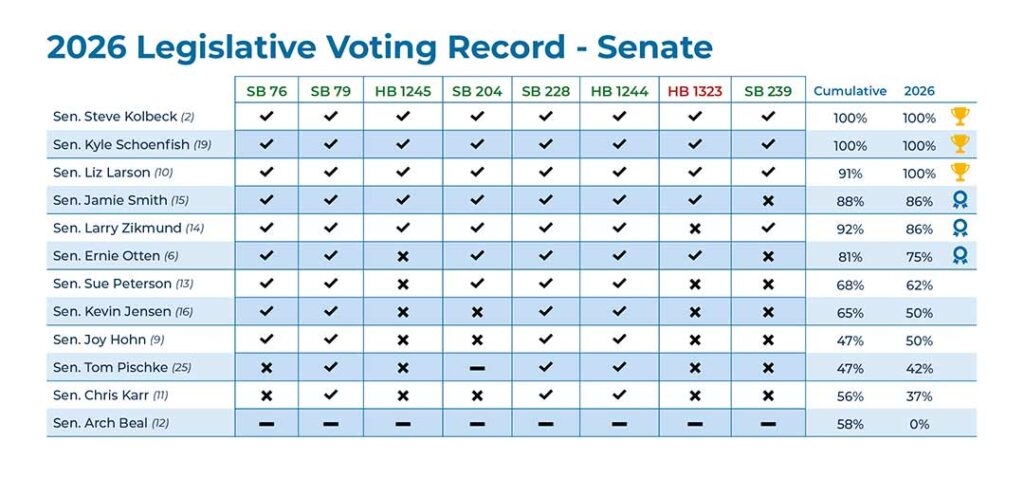
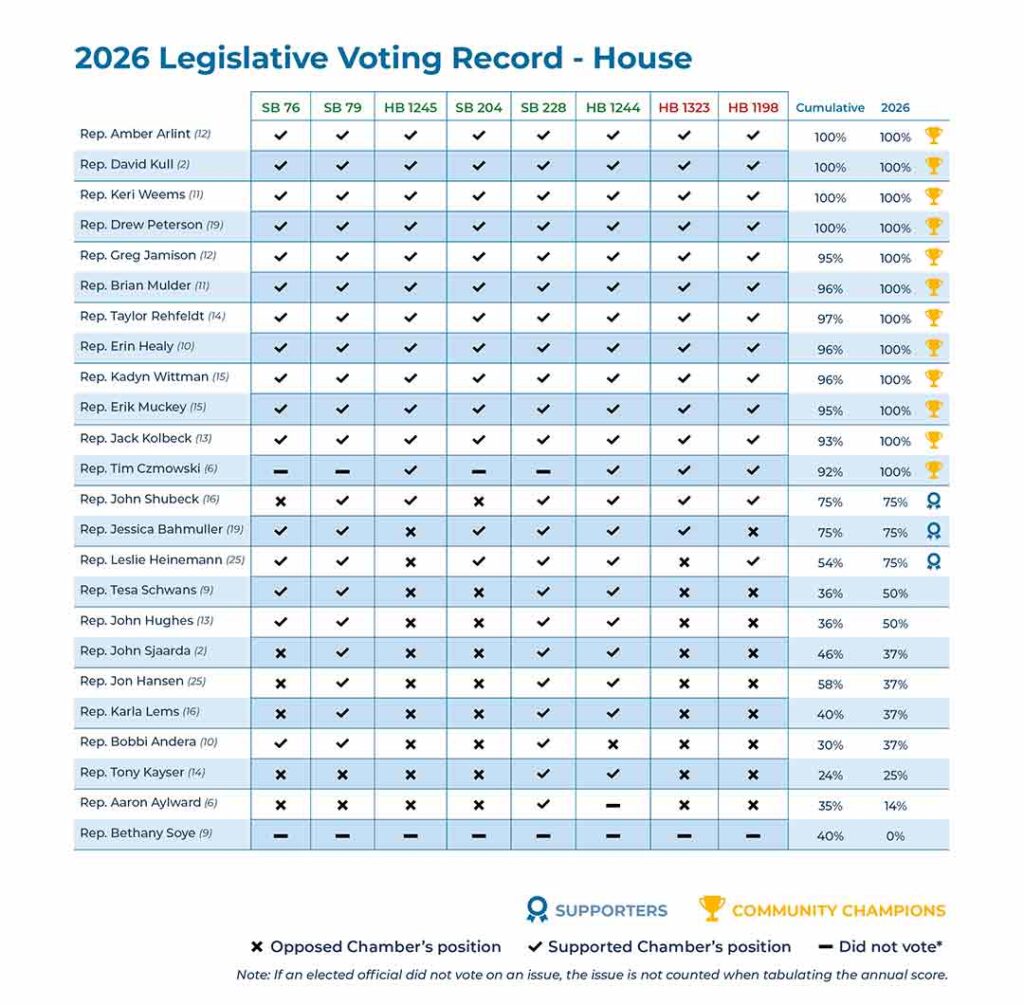
Each year, the Chamber compiles a Legislative Scorecard to help members understand how Sioux Falls-area legislators voted on key bills during the session. These are the bills where the Chamber took a formal position, based on the legislative platform set by the Issues Management Council (IMC) and approved by the Board of Directors.
How the Scorecard Works
The Scorecard highlights select legislation with a direct impact on the Sioux Falls business community. It shows whether each legislator’s vote aligned with the Chamber’s position on the final form of each bill, as considered by the full House or Senate. Only legislation that was considered by the entirety of one or both legislative bodies are recorded on the scorecard. Recorded votes correspond to the final form of each bill that was considered by each legislative body, and the Greater Sioux Falls Chamber’s position on the final form of that piece of legislation.
The Scorecard is not an evaluation of any individual lawmaker. It serves as a factual record of how legislators voted on issues important to the Chamber, its members and the Sioux Falls business community.
Legislators who voted with the Chamber 100% of the time earned the Sioux Falls Community Champion designation. Those who aligned on at least 75% of the bills were recognized as Sioux Falls Supporters. These designations reflect 2026 voting records, with cumulative scores included to show long-term alignment with Chamber positions.
Bills Included in the 2026 Legislative Scorecard
SB 76 – Authorize loans from the South Dakota housing infrastructure fund for airport infrastructure.
The Chamber supported this bill. It passed the Senate 22-11, passed the House 43-23, and was signed by Gov. Rhoden.
SB 76 created a 2 percent loan of up to $15 million for the Sioux Falls Regional Airport to use for its terminal expansion project. Passenger traffic continues to break records each year at the facility, and the upgrade is much needed to accommodate more travelers with the addition of four gates and more seating. This loan from the state pairs with federal dollars, as well as a $5 million loan from the City of Sioux Falls. The loan comes from federal funds located in the Housing Infrastructure Fund (HIF), to which the funds will be repaid. This creates more funding over time for the HIF to support workforce housing, while also supporting a critical public transportation need.
SB 79 – Make an appropriation to the South Dakota Board of Technical Education to construct an advanced manufacturing laboratory space and classrooms on the campus of Southeast Technical College and to declare an emergency.
The Chamber supported this bill. It passed the Senate 29-4, passed the House 53-14, and was signed by Gov. Rhoden.
SB 79 allocated $6 million in one-time funding to Southeast Technical College for construction of the James Abnor Advanced Manufacturing Center. This new space will allow Southeast Technical College to expand its advanced manufacturing, welding and other technical programs to address a growing number of students seeking these careers. These state funds are also accompanied by federal, local and private funding.
HB 1245 – Authorize municipalities to establish a local funding mechanism for capital improvement projects.
The Chamber supported this bill. It passed the House 36-30, passed the Senate 19-15, and was signed by Gov. Rhoden.
HB 1245 allows for a voter-approved temporary 1 percent sales tax increase that would go toward funding capital projects in local communities. Many communities across the state lack the funding capacity to address capital needs such as water and wastewater infrastructure, community event facilities, parks and recreation, and more. These projects must be approved by more than 60 percent of voters in each individual community, and the temporary sales tax increase ends when project costs are met or after five years, whichever comes first. By using this funding mechanism, municipalities can avoid bonding for projects and save taxpayers millions of dollars in interest payments over time.
SB 204 – Revise certain criteria for loans from the South Dakota housing
infrastructure fund.
The Chamber supported this bill. It passed the Senate 20-13, passed the House 42-25, and was signed by Gov. Rhoden.
SB 204 amends some of the guidelines within the Housing Infrastructure Fund created by the South Dakota Legislature in 2023. This fund is meant to cover the public infrastructure costs associated with new housing developments in South Dakota. When the fund was created in 2023, applicants could have only one-third of those associated costs covered. With the passage of SB 204, up to one-half of those costs can be covered by HIF funding. This will encourage more housing development in South Dakota, which is greatly needed for today’s workforce.
SB 228 – Modify provisions for a tax increment financing district.
The Chamber supported this bill. It passed the Senate 33-0, passed the House 67-0, and was signed by Gov. Rhoden.
SB 228 creates common-sense guardrails around the use of Tax Increment Financing (TIF) districts. It ensures that TIFs are not misused, are not created without proper financing ability by an entity, are used in areas that would benefit from the creation of a TIF, and pass an independent fiscal feasibility study. This will continue to allow responsible TIF use in the greater Sioux Falls area.
HB 1244 – Repeal the special donations fund and make an appropriation to the Department of Education for the provision of a grant to support the Jobs for America’s Graduates-South Dakota program.
The Chamber supported this bill. It passed the House 51-14, passed the Senate 30-4, and was signed by Gov. Rhoden.
HB 1244 appropriated $500,000 to the Jobs for America’s Graduates (JAG) program in South Dakota. JAG-SD supports students who face barriers to success and equips them with the skills they need to thrive — right here at home. These students learn job skills, effective communication, how to apply for employment, how to manage finances and more. This program helps build the workforce South Dakota needs.
HB 1323 – Modify the requirements to refer an ordinance or resolution to the voters of a political subdivision.
The Chamber opposed this bill. It passed the House, was amended in the Senate, and ultimately failed to receive House concurrence on a 40-27 vote.
HB 1323 would have lowered the threshold needed for citizens to refer ordinances and resolutions in any political subdivision. This bill specifically targeted South Dakota’s largest counties and municipalities by drastically decreasing the number of signatures needed on a petition to refer any ordinance or special resolution to a special election. If passed, it would have made it fairly easy to refer nearly any action approved by a county or municipal government, creating a standstill in local government and roadblocks to future development, public safety and more.
HB 1198 – Require that certain facilities obtain conditional use permits from adjacent political subdivisions.
The Chamber opposed this bill. It failed in the House on a 21-41 vote.
HB 1198 would have allowed a political subdivision within a mile of a proposed high-energy-use facility in a neighboring subdivision to veto approval of a conditional use permit. HB 1198 sets a bad precedent by allowing neighboring political subdivisions to overrule actions approved by another local government. For example, if the City of Sioux Falls approved a conditional use permit, the Lincoln County Commission could overrule that decision if the proposed site was within a mile of the county. If passed, HB 1198 would have essentially stripped municipalities of their ability to make decisions for their own territories if a county government disagreed with that decision.
SB 239 – Modify provisions relating to the reinvestment payment program, and relating to the purchasing of goods and services used by projects approved for the reinvestment payment program.
The Chamber supported this bill. It failed in the Senate on a 16-17 vote.
SB 239 proposed expanding and modifying the state’s Reinvestment Payment Program (RPP), primarily by allowing the state to offer more flexible financial incentives, such as partial rebates on large equipment purchases, to attract major economic development projects.