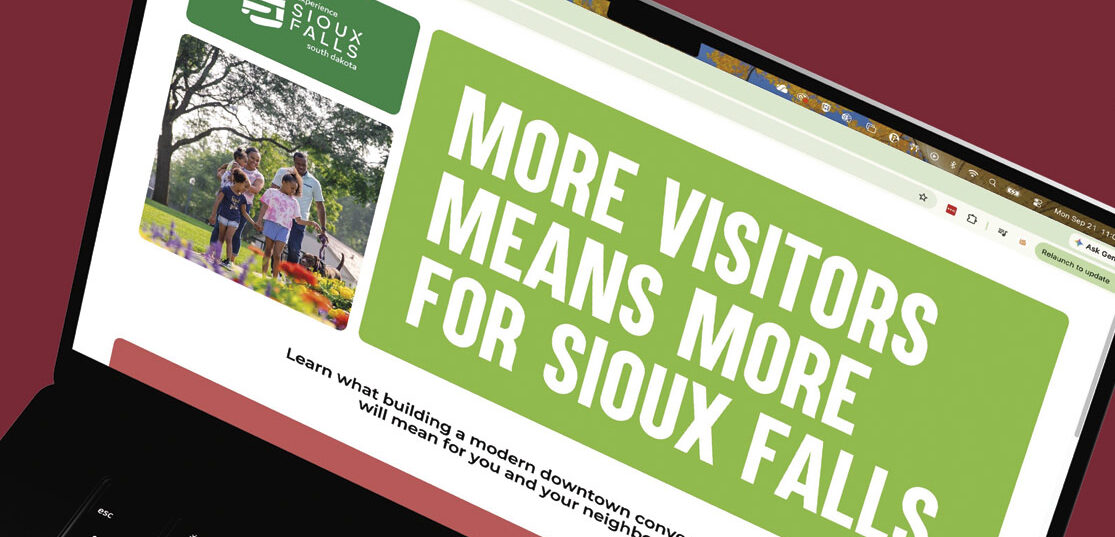
More Visitors Means More for Sioux Falls: The Vision for a Downtown Convention Center
A modern downtown convention center would bring more visitors, outside dollars and economic opportunity to Sioux Falls
Sioux Falls has changed considerably since its current convention center opened in 1997. Since then, the city, its visitor industry and expectations for convention destinations have evolved.
In 2025, Sioux Falls welcomed an estimated 3.4 million visitors. Those visitors supported more than 10,000 local hospitality jobs.
In May, Forward Sioux Falls and Experience Sioux Falls committed funding and leadership to advance the vision for a modern downtown convention center. Together, the organizations formed a working group of stakeholders to build understanding of what an investment could unlock for Sioux Falls and support taking the next steps.
The effort comes at a pivotal time. The Arena, which provides convention and trade show overflow space, is at the end of its useful life and faces significant maintenance needs within the next few years. At the same time, long-term planning is underway for downtown, and continued investment at the Sioux Falls Regional Airport is strengthening the city’s ability to welcome visitors.
Together, those developments make this an important time to think long-term about Sioux Falls’ convention infrastructure, before significant investments are made and as other pieces of the city’s future are taking shape.
The existing convention center continues to play an important role in Sioux Falls’ event infrastructure. It is heavily used and particularly well suited for events requiring large, flat-floor space and convenient access for trailers and equipment. Those strengths are important to preserve.
“The challenge we face is really twofold: capacity and location,” said Teri Schmidt, CEO of Experience Sioux Falls. “There are events Sioux Falls can’t accommodate today because we simply don’t have enough convention space. At the same time, planners expect hotels, restaurants and entertainment within walking distance. Sioux Falls has those amenities downtown, but we don’t have a convention facility that connects them.”
Capacity is already limiting the convention business Sioux Falls can pursue. The current convention center is frequently booked, and larger conventions and trade shows can require overflow space in the Arena and Denny Sanford PREMIER Center.
Location presents a different challenge. Convention planners expect a destination that can provide hotels, restaurants, retail, entertainment and other amenities within walking distance. Downtown Sioux Falls already has many of those amenities. What it lacks is a convention facility.
The scale of the missed opportunity is significant. A sample of 329 convention opportunities lost in 2024 and 2025 represented approximately $293 million in estimated economic impact. The reasons events selected another city varied, including convention space and availability, hotel connectivity and walkability. The figure does not mean a new facility would have secured all of that business, but it illustrates the size of the convention market Sioux Falls is competing for.
Those challenges are what Experience Sioux Falls and Forward Sioux Falls believe a modern downtown convention center could address. The vision is not to replace the current convention center, but to expand what Sioux Falls can offer with two facilities serving different purposes. The existing center would build on its strengths as an exhibition center for trade shows, agricultural and rural events and other uses that benefit from large flat-floor space and equipment access. A modern downtown convention center would allow Sioux Falls to pursue larger regional and national conventions seeking additional capacity and a walkable visitor experience.
“What happens around a convention center is just as important as what happens inside the building,” said Brandon Hanson, President and CEO of Downtown Sioux Falls, Inc. “Visitors that eat, shop and spend money at local businesses, which provides stability for those businesses to continue to provide the best possible service to residents.”
The goal is to expand Sioux Falls from approximately 20 regional conventions annually to an average of 100 conventions and 450,000 attendees, including national events. Johnson Consulting estimated a modern downtown convention center could generate more than $235 million in economic impact during its first five years, more than $70 million in increased earnings and support the equivalent of 278 ongoing full-time jobs.
But the larger opportunity is about bringing more outside dollars into Sioux Falls and what those dollars can make possible for the people who live here.
“Conventions bring outside dollars into Sioux Falls,” said Jeff Griffin, President and CEO of the Greater Sioux Falls Chamber of Commerce. “When someone from another state spends $100 at a local restaurant, new money has entered our economy.”
And that’s where the convention center conversation becomes a quality-of-life conversation.
The benefits extend beyond the businesses that directly serve visitors. Tax revenue generated by visitor spending helps Sioux Falls invest in services and infrastructure residents use every day, meaning a stronger visitor economy can benefit people who may never attend a convention themselves.
Visitor spending already generates more than $126 million in state and local taxes, offsetting the tax burden on Sioux Falls residents by an estimated $1,462 per household. Visitor-generated taxes also help support public services and infrastructure, including parks, pools, libraries, public safety, recreational trails and streets.
That is the idea behind More Means More: more visitors mean more outside dollars in Sioux Falls, supporting more of the amenities and services that make this a great place to live.
Significant questions remain, including where a new downtown convention center could be located and how it could be funded. For now, Experience Sioux Falls and Forward Sioux Falls are focused on building community understanding and support for the vision. If Sioux Falls is ready to take the next step, those questions can be answered together.
“We’ve built a city people want to visit and that residents are proud to call home,” Schmidt said. “Now we have an opportunity to think about what more visitors could unlock for Sioux Falls and what the next chapter could look like for our community.”