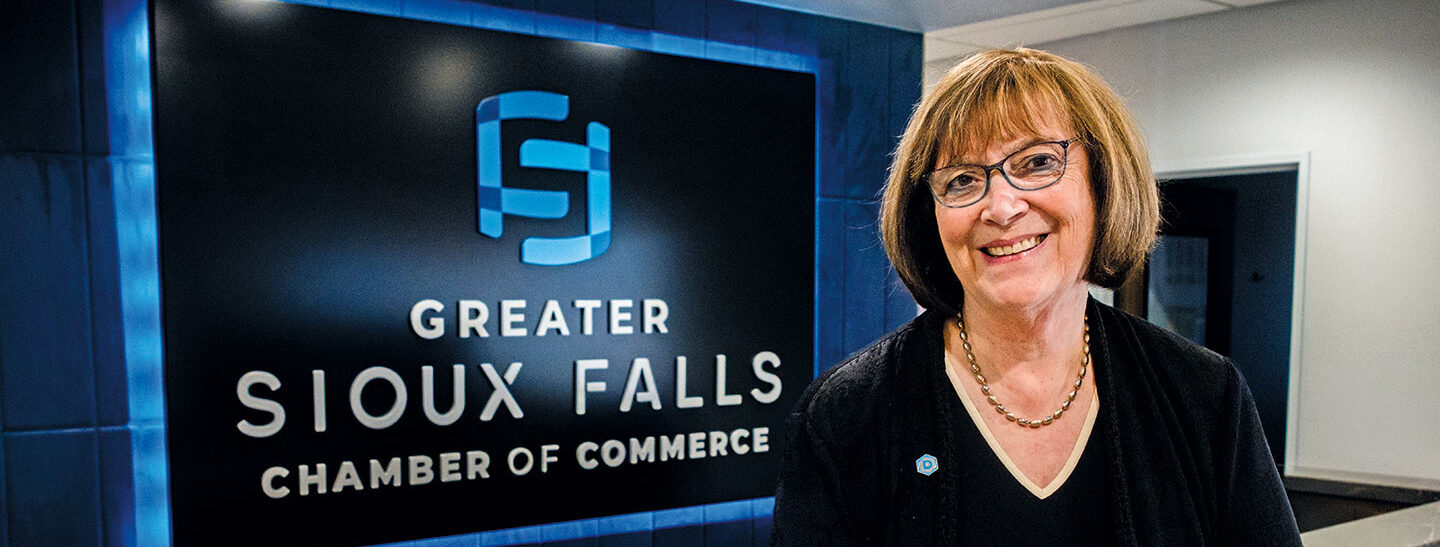
Dr. José-Marie Griffiths: Leading at the Edge of Revolution
José-Marie Griffiths has spent decades working at the leading edge of computing, cybersecurity and artificial intelligence. Now, as Chamber chair, she is focused on helping businesses prepare for what comes next.
In the Washington, D.C., rooms where experts gathered to discuss advanced computing and the emerging internet, José-Marie Griffiths was often one of few women present. She knew that even after a substantive conversation, someone might walk away without remembering her name. So she gave them something else to remember.
Griffiths began wearing brightly colored jackets to meetings. If her name escaped someone later, perhaps they would still recall talking with “the lady who had the bright green jacket.” The bright jackets helped her stand out. She was more measured in how she spoke. “I don’t talk too much,” Griffiths said. “But when I do talk, I want everyone to listen.”
Her career has taken her through early computing, cybersecurity, artificial intelligence, technology policy and higher education leadership.
Griffiths led Dakota State University as president for more than a decade, beginning in 2015. In June 2026, she moved into the newly created role of chancellor as John Ballard became the university’s president. Now, she is also beginning a year as chair of the Greater Sioux Falls Chamber of Commerce.
“I’ve never followed a traditional path,” she said. “But it is cumulative, and you pick up expertise and skills in certain areas and bring them along.”
A native of London, Griffiths originally intended to become a theoretical nuclear physicist. At University College London, women were still rare in physics. When summer internships came around, Griffiths noticed something else: none of the women in her class got one.
Griffiths went on to pursue a doctorate in computer simulation.
“I hated computer programming when I took my first course,” she said.
The required Fortran class did not appeal to her at first. But she started experimenting with other languages, and classmates in her residence hall began coming to her for help. That was when Griffiths realized she might be better at it than she thought.
Her first job put those skills to use at the Imperial Cancer Research Fund laboratories in London, now part of Cancer Research UK, where she served as the inaugural director of research computing. “Nobody on the research side was using a computer,” Griffiths said. “A few people were using calculators.”
She started with researchers who had a clear use for the technology. Geneticist Walter Bodmer was working on protein folding and early DNA analysis and needed computing power for that work. “Gradually, the research directors would come and see me,” Griffiths said.
As databases emerged, Griffiths also worked with text, images and chemical structures.

The work led her into disciplines that would become recurring threads in her career. Her work with artificial intelligence began in the 1970s, when she worked on automatic language translation while still an undergraduate. In the 1980s, Griffiths worked with neural networks. By 1989, she was working in computer security at Oak Ridge National Laboratory.
Her work also carried her into national technology policy, including presidential advisory roles and the National Security Commission on Artificial Intelligence, where she focused on workforce and responsible AI.
By the time Griffiths’ late husband, Don King, came across the Dakota State University presidency opening in 2015, several strands of her career had begun to converge.
King encouraged her to take a closer look. The university’s mix of programs, its size and the close interaction between faculty members and students caught her attention.
“That’s why DSU was the perfect place for me to land,” Griffiths said. “When people who know me say, ‘Why did you go there?’ Well, it made sense.”
A family member put it another way: “If they ever designed a university for you, it was DSU.”
After the final day of interviews in Madison, Griffiths received a call offering her the presidency. Within a couple of hours, she had talked it through with King and her daughter and accepted.
Griffiths spent her first months listening and gathering information. By 2016, AI was on her list. “I said, ‘We have to start moving into AI,’” Griffiths said. “We were teaching the elements of AI in computer science — pattern recognition, neural nets, machine learning. But I said, ‘It’s coming.’”
DSU hired its first faculty member with specific AI expertise that year. Griffiths also pushed growth in cybersecurity and, later, quantum computing. “It’s not restricted,” she said of DSU’s mission. “It’s focused.”
Griffiths also wanted more people across South Dakota to understand what DSU had become. She said an early statewide survey found about 16% of respondents knew something accurate about the university. Five or six years later, after a rebrand and concerted marketing effort, that figure had risen to about 83%.
Graduate outcomes were another point of pride. Griffiths said placement was about 94% when she arrived and had climbed to more than 99% during her tenure. But growth created another challenge.
Griffiths worried that without more research and employment opportunities in South Dakota, DSU would educate more technology graduates who would leave for jobs elsewhere. That concern helped drive the university’s expansion in Sioux Falls.
Sioux Falls was already home to DSU students, alumni and employers of its graduates. A stronger presence could connect the university’s work in Madison with applied research, private industry and economic development.
“Madison is the engine,” Griffiths would tell people as DSU expanded its presence in Sioux Falls. Madison would supply the graduates and research, while Sioux Falls could create more opportunities for them to build careers in South Dakota.
The relationship also reflected Griffiths’ view that public universities should provide tangible value to the communities and states that support them.
Griffiths recently moved to Sioux Falls, where she is preparing for her year as chair of the Greater Sioux Falls Chamber of Commerce. She said her first priority is to understand member issues and help represent their interests with policymakers, while bringing her experience in technology and workforce development.
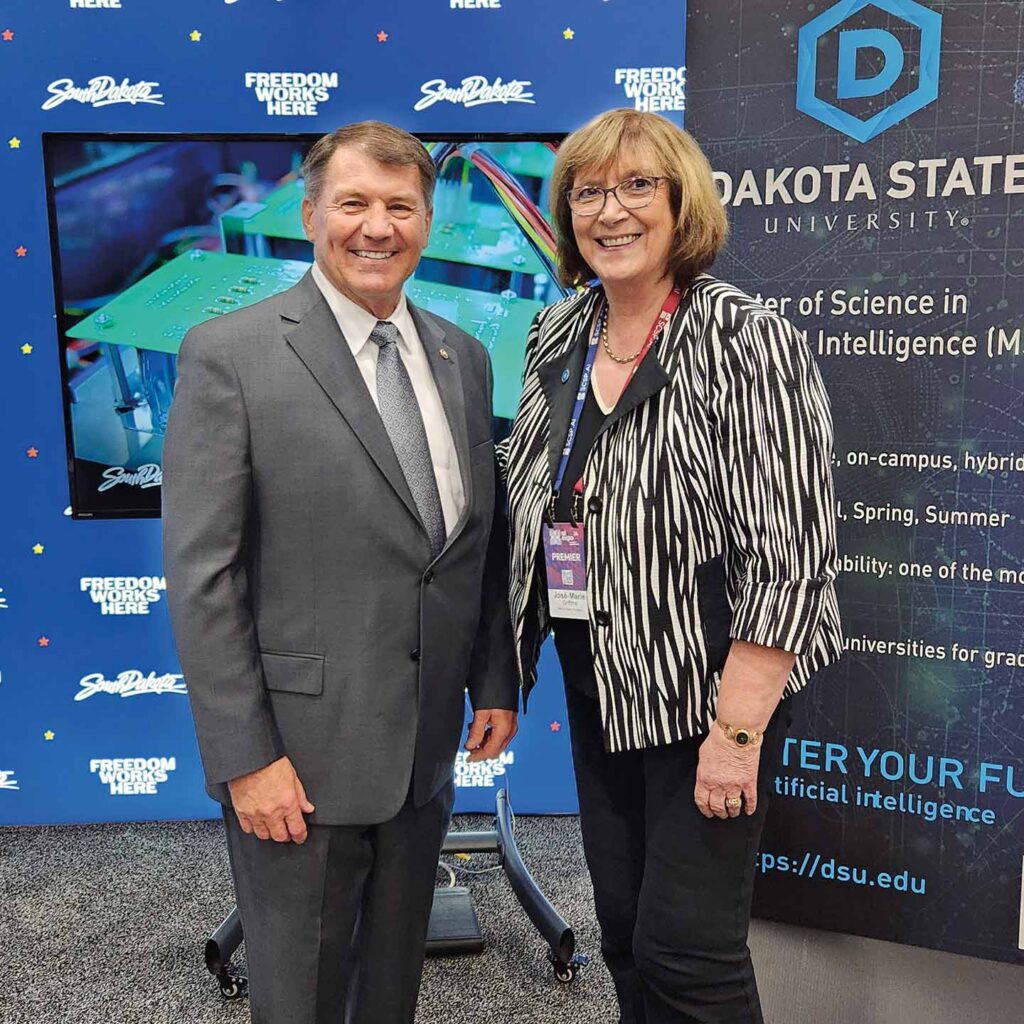
For Griffiths, workforce development is also about the skills businesses will need as their industries change.
“What are my students going to need to know four years from now, five, six, seven, eight, nine, ten years from now?” she asked.
That same concern carries into how she thinks about artificial intelligence. Griffiths said small and midsized businesses are still working through where AI makes sense, what it will cost and where they are likely to see a return.
Her advice is to examine the work a business does and decide where AI could be useful, rather than trying to apply it everywhere — and to understand the risks that come with it.
AI does not reduce the need for cybersecurity, she said. “In fact, it increases the need for cybersecurity.”
Griffiths has spent much of her career advocating for technology. Increasingly, she also argues for the things it cannot replace. “I know it’s weird,” she said. “Here I am, the biggest proponent of technology, talking about, ‘It’s not all about technology.’”
She believes the humanities and social sciences will become more important as automated systems become more capable. AI-generated writing already has a recognizable tone, she said, and can become “almost more of a parody of itself.” “We can’t give up on the arts and sciences, especially the humanities,” she said. They remind people “of who we are and why we’re here.”
The value Griffiths places on the arts is personal, too. Music became an important source of comfort after King’s passing in 2019. She now serves as president of the South Dakota Symphony Orchestra Board of Directors.
She also worries about younger students relying on large language models before they have developed their own ability to question, evaluate and create. “We shouldn’t use it for everything,” she said.
By the end of her year as Chamber chair, Griffiths hopes members feel better prepared for what is coming — and more confident deciding where technology can help.
For someone who has spent much of her career watching new technologies emerge, that may be the most practical measure of success: helping people understand what is changing and what to do with it.